From PDF to micro-course in minutes: the AI Co-pilot that transforms your documents into training

The knowledge your company needs, in all likelihood, already exists. It is in the sixty-page safety manual, the onboarding slides, the GDPR policy that someone wrote with care and almost no one has read all the way through. For L&D and HR teams, the problem is rarely a lack of content. The bottleneck is that a document, no matter how accurate, is not training. Transforming it into something people actually learn from is the slow and expensive part, where good material ends up stranded in a shared folder.
The AI Co-pilot of Evolve steps in exactly here: it takes those documents and transforms them into micro-modules ready for use. Let's look closely at how this architecture works and why the output guarantees real learning.
The problem is not the content, it is the time to transform it
How much does it cost, in working hours, to convert a technical manual into a course? Much more than people tend to estimate. The reference research in the sector, conducted by the Chapman Alliance on about 250 organizations and 4,000 training professionals, measured the ratio between development hours and one hour of produced training.
For one hour of basic-level e-learning, an average of about 80 development hours is needed. If you move to more interactive modules, it exceeds 180 hours, while in cases of advanced design, it approaches 700 hours. In terms of the calendar, producing a handful of courses can absorb months of work.
With metrics of this kind, the choice for many teams becomes forced: the manual remains a manual. The PDF is uploaded to the intranet, a signature for acknowledgement is requested, and the task is considered done. The knowledge exists, it is well written, but it never translates into a concrete change in the way people work.
A PDF is not training: the constraint of the forgetting curve
Even assuming that people read the document in its entirety, what remains of it after a week? The psychology of memory has analyzed this phenomenon for over a century. The forgetting curve described by Hermann Ebbinghaus demonstrates that, in the absence of structured reminders, we forget most information within a few days. Reading a policy once and signing a form is not learning; it is superficial contact with information destined to fade.
Training teams often fall into a perceptual trick: rereading a text generates a strong sense of familiarity that is mistaken for mastery of the concept. Long-term memory is instead built through opposite processes: the active recall of information, spaced repetition over time, and continuous testing. The format of the content therefore matters more than the delivery speed.
How Evolve's AI Co-pilot steps in
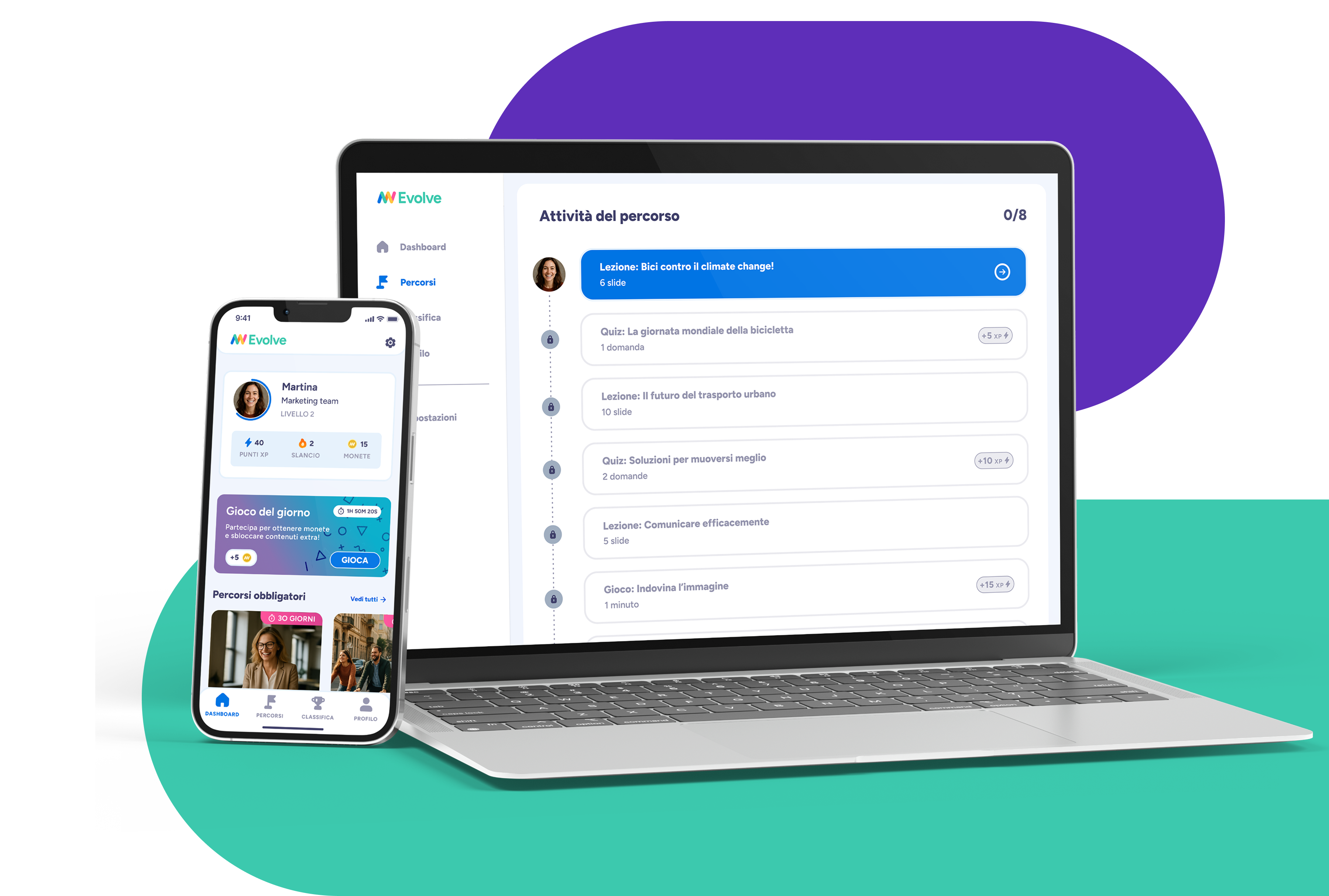
Evolve is the learning experience platform designed to bridge the gap between static documentation and actual learning. The AI Co-pilot Evolve automates the transition from legacy materials to interactive paths through a direct flow.
The user uploads existing material, such as PDFs, Word files, or slide presentations. The document importer reads the text and breaks it down into micro-modules consisting of stories (short readings with high visual impact) and verification quizzes. A sixty-page manual is thus transformed into a sequence of digestible units, eliminating walls of text. The same assistant allows you to:
- Create stories starting from a simple textual brief.
- Generate quiz from document or from content already uploaded to the platform.
- Receive real-time suggestions to optimize text clarity.
The work of reading, synthesizing, breaking down, and formulating questions used to require hours of instructional design; now it happens in a few minutes inside the editor. This structural efficiency makes it possible to transform PDF into training that is measurable, recording completion rates up to 80% higher than traditional LMS systems.
The scientific foundations of distributed microlearning
Accelerating the creation process does not negatively affect the quality of the output. The format generated by the Co-pilot (short readings paired with distributed tests) applies the core principles of the science of learning.
Quizzes are not simple evaluation tools, but educational devices. In Roediger and Karpicke's study published in Psychological Science, retention levels were compared between those who reread a text and those who were tested on that same text. One week later, the group dedicated to rereading alone had forgotten 56% of the information, while the tested group had lost only 13%. This phenomenon, known as the testing effect, demonstrates that the act of recalling information from memory consolidates it more effectively than simple viewing.
1.Extraction and breakdown:
The AI analyzes the PDF or legacy file, isolates key concepts, and eliminates textual redundancies.
2.Generation of micro-modules:
The text is converted into short stories and targeted quizzes are formulated to stimulate active recall.
3.Distributed delivery:
Microlearning that lands and lasts
Help your people grow with bite-sized, gamified training. 30M+ learning actions across 500+ enterprises.
Modules are proposed to the user according to a microlearning logic to exploit the spacing effect.
4.Reinforcement of error:
The final verification automatically proposes the questions missed during the path, guaranteeing repetition until the concept is mastered.
To this is added the spacing effect: distributing learning into short sessions separated over time stabilizes memory better than a single intensive session. Evolve translates this principle into a precise mechanic: the final verification of the paths re-proposes the quizzes missed along the way, allowing unlimited attempts until passing. The user does not pass the test by pure chance, but corrects the error until consolidating the concept.
The role of the L&D team: from mechanical work to strategic design
Automation does not replace the human factor, but redefines its boundaries. The Co-pilot provides an advanced and structured draft, zeroing out the hours dedicated to mechanical formatting, text synthesis, and writing questions from scratch.
The responsibility of the training professional shifts to quality control: verifying the accuracy of the content, calibrating the corporate tone of voice, selecting key messages, and adapting the register to the target audience. The drag-and-drop editor and AI suggestions are designed to optimize this review work. Thanks to artificial intelligence, L&D teams stop performing repetitive copying tasks and focus entirely on the strategic design of the learning experience.
Frequently asked questions
What kind of documents can be processed with Evolve?
The AI Co-pilot document importer supports PDFs, Word files, and slide decks, automatically converting them into stories and quizzes integrated into gamified training paths.
What are the actual development times to create courses with AI?
The initial conversion of documents takes a few minutes. The remaining working time is dedicated exclusively to reviewing content, approving the draft, and calibrating the tone, eliminating the phase of writing from a blank page.
How does microlearning from documents maintain high training quality?
The algorithm translates texts into formats validated by scientific research. The combination of microlearning (short sessions to avoid cognitive overload) and the testing effect (frequent quizzes to counter the forgetting curve) guarantees a higher retention rate than passive reading.
Does the AI Co-pilot replace the skills of L&D professionals?
No. The tool takes care of the synthesis and first-draft activities. Critical judgment on the accuracy of information, strategic relevance, and the final personalization of the experience remain entirely human tasks.
A strategic evaluation
How much corporate knowledge is currently locked in documents that no one consults because their transformation requires too many resources? A static PDF represents isolated knowledge. A path structured into stories and quizzes, aligned with the biological mechanisms of memory, ensures the real spread of skills within the organization.
If you want to test the effectiveness of our system on your company materials, discover the employee education services on Evolve's website and request access to the platform.
Sources
- Roediger, H. L., & Karpicke, J. D. (2006). Test-Enhanced Learning: Taking Memory Tests Improves Long-Term Retention. Psychological Science, 17(3), 249–255.
- Ebbinghaus, H. (1885). Über das Gedächtnis (Memory: A Contribution to Experimental Psychology).
- Cepeda, N. J., Pashler, H., Vul, E., Wixted, J. T., & Rohrer, D. (2006). Distributed Practice in Verbal Recall Tasks: A Review and Quantitative Synthesis. Psychological Bulletin, 132(3), 354–380.
- Chapman Alliance (2010). How Long Does it Take to Create Learning? (Statistical survey on ~250 organizations and ~4,000 L&D professionals).
- Internal metrics of the Evolve platform (AWorld Tech).
Ready to engage your people?
AWorld helps enterprises drive engagement through education, sustainability, and gamification.
Talk to our teamChange is in our hands
AWorld supports your journey toward sustainability and well-being, turning your stakeholders into true agents of change.
Contact us